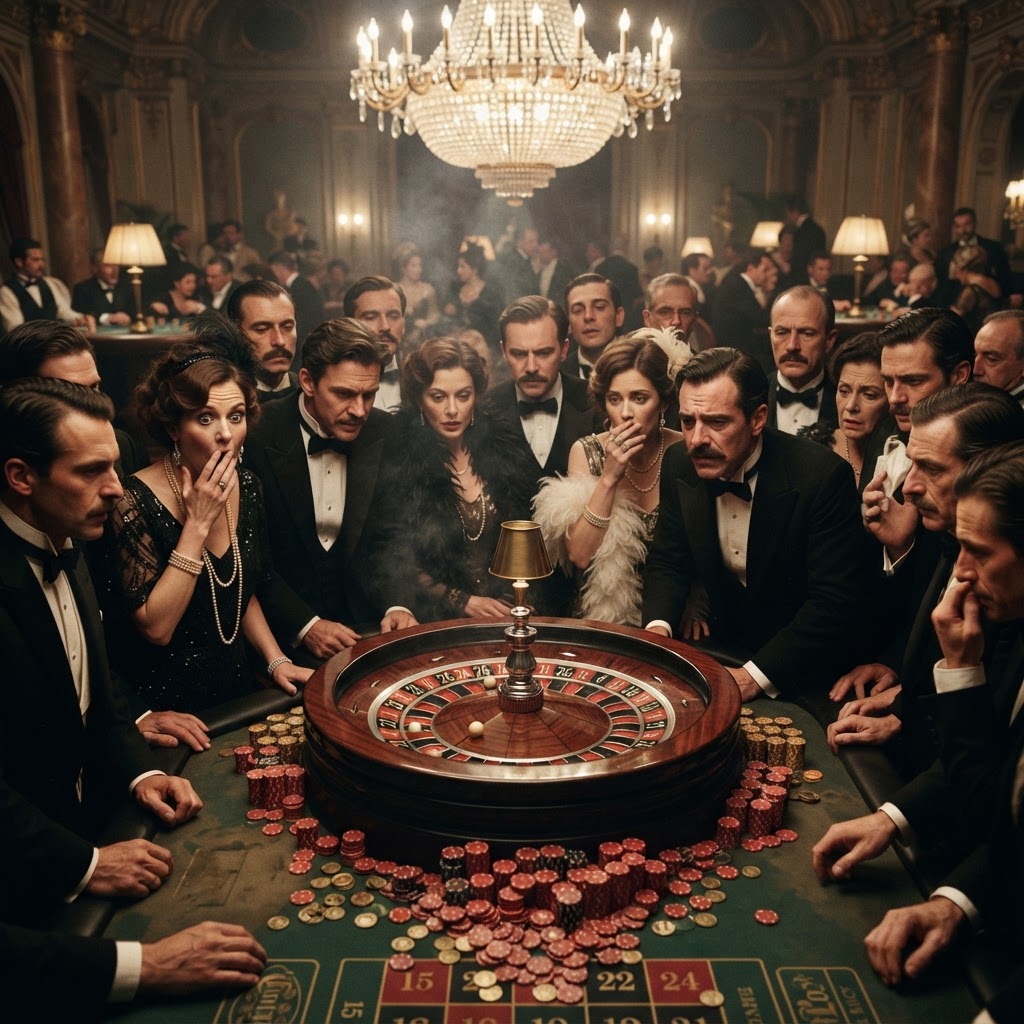
On 18 August 1913, a roulette ball landed on black 26 times in a row at a Monte Carlo casino. As the streak went on, players bet heavily on red, convinced it had to come up soon, and lost millions. The Monte Carlo roulette streak illustrates the gambler’s fallacy, also called the Monte Carlo fallacy. It’s the belief that chance keeps score and must even itself out. It doesn’t. On a fair wheel, black was exactly as likely on the 26th spin as on the first.
What happened at the wheel
The ball fell on black, then black again. As the run lengthened, the crowd came to believe the odds were shifting towards red. As cognitive scientist Tom Stafford wrote for BBC Future, they bet on red “believing that the chances changed with the length of the run of blacks”.
The run itself really was rare. On a single-zero wheel, 18 of the 37 pockets are black. The chance of 26 spins in a row landing on the same colour, red or black, is about 1 in 68 million. But rare is not impossible, and the more often a wheel is spun, the more chances a rare run has to turn up somewhere.
Why the wheel has no memory
A wheel, a coin or a die has no way of knowing what it did last time. Each spin is independent, so a run of blacks makes red no more likely on the next one.
Great Britain’s Gambling Commission includes the same principle in its technical standards for online games. When a game simulates a physical device, its probabilities should match the real thing. For example, “the probability of a coin landing heads must be 0.5 every time the coin is tossed”. The standards also ban “compensated” games that adjust their odds during play.
The streak only looks special because people noticed it. Any one exact sequence of 26 reds and blacks is just as unlikely as 26 blacks: red, black, red, black and so on, 26 times over, is no more probable. With a fair coin, 20 heads followed by a tail is precisely as likely as 21 heads.
A coin that kept landing heads
Theatre has played with this, too. Tom Stoppard’s Rosencrantz and Guildenstern Are Dead, which premiered at the Edinburgh Fringe on 24 August 1966 and opened at the Old Vic in April 1967, begins with a coin landing heads 92 times in a row. The joke works because everyone knows it shouldn’t happen, yet nothing in the laws of chance forbids it. For more stage stories, explore our guide to LGBTQ+ theatre in London.
Real coin-tossers have tested the long run. In the 18th century the naturalist and mathematician Georges-Louis Leclerc, Comte de Buffon, tossed a coin 4,040 times and got 2,048 heads. In the early 20th century the mathematician Karl Pearson tossed one 24,000 times and got 12,012. The share of heads came out close to half, but no toss along the way was nudged back into line. As Stafford puts it, for truly random events “there is no force which makes clumps more or less likely to continue”.
Lottery numbers and lucky streaks
The fallacy turns up wherever people pick numbers. A 1991 National Bureau of Economic Research study looked at a US state’s daily numbers game. The amount bet on a number fell sharply after it was drawn. It then took several months to recover. Players appeared to treat a recent number as less likely to come up again.
Its mirror image is the “hot hand”, the belief that luck comes in streaks and a winning run will carry on. Stafford argues that both errors show “an unreasonable faith in the non-randomness of the universe”. The ball does not care which way the crowd is leaning.
The zero, not the streak
There was one thing at that 1913 table worth thinking about, and it was not the colour. Red and black each cover 18 numbers, and both lose when the ball lands on the green zero. That single pocket, not any run of colours, is what gives the house its edge.
The same maths applies if adults aged 18 and over try roulette at Fortune Games, where a random number generator decides each result in the computer-dealt games. As its guide says, past numbers don’t make any number more or less likely, and no system changes the odds. Every spin is random, no streak or hunch changes that, and the house keeps its edge, so treat it as paid entertainment.
The wheel in Monte Carlo had no idea it had landed on black 26 times. Neither does any other.
18+ only. Treat any game as paid entertainment, never a way to make money. Free, confidential help 24/7: National Gambling Helpline, 0808 8020 133.
For a change of scene, explore queer culture and nights out in the GLL Events Diary.