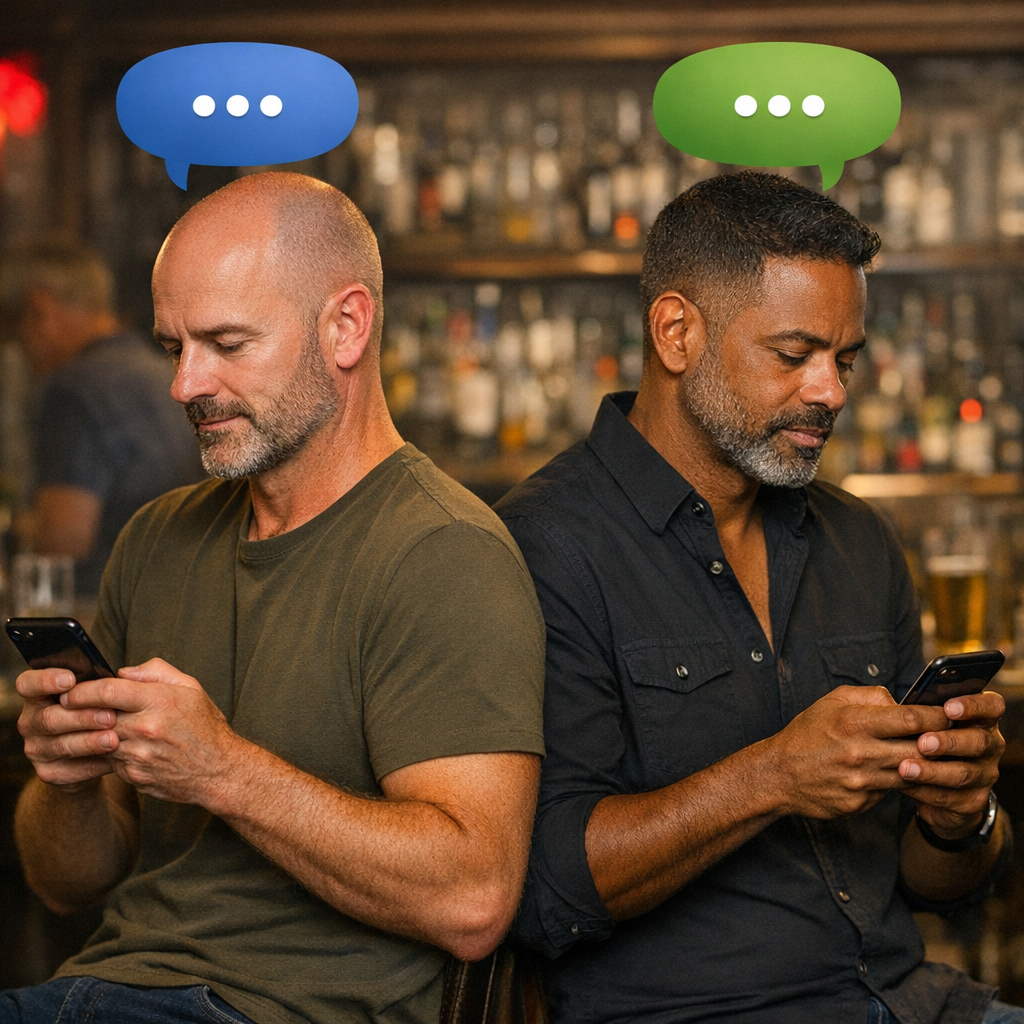
If you ever want to understand the modern gay dating scene in London, stand on Old Compton Street for ten minutes and just watch. You’ll see two men — both handsome, both clearly interested — standing a few feet apart, pretending not to notice each other while simultaneously messaging each other on an app. It’s the kind of behaviour that would be absurd anywhere else, but here it’s practically a local sport. London is the only city where you can flirt with someone online while physically queuing behind them for a drink. And somehow, we’ve all agreed this is normal.
This is the Soho Spin — the strange loop where some of the most eligible gay men in the world stay single in a city overflowing with opportunity. You’d think connection would be easy here. You’d think the sheer density of gay life would make dating a breeze. But London has a way of distracting us with so many options that we forget to actually choose anything. The apps never stop buzzing. The notifications never stop pulling our attention away from the people right in front of us. You can be surrounded by hundreds of men and still feel like you’re alone in a crowd, scrolling through profiles of men who are also scrolling through profiles of men who are also scrolling. It’s a hall of mirrors with abs.
And yet, beneath the humour of it all, there’s something more tender going on. Most gay men in London aren’t avoiding relationships because they don’t want them. Many do. Deeply. But the city gives us endless ways to avoid the vulnerability required to build one. There’s always another swipe, another torso, another “Hey handsome. What are you into?” from someone who lives two stops away on the Northern line. And when you can scroll through men like you’re browsing Deliveroo, it becomes very easy to convince yourself that the next one will be better, hotter, more emotionally available, less complicated, more “your type,” or whatever story you tell yourself to avoid taking a real-world risk.
And let’s be honest: the phone is safer. If you message someone instead of talking to them, you never have to deal with the awkward hello, the possibility of rejection, or the terrifying moment where you have to be a real human being instead of a curated profile. London’s gay scene is full of men who would rather send a text on Grindr than say a single sentence out loud. It’s not because they’re shy. It’s because the screen gives them control — and control feels easier than vulnerability. You can edit a message. You can delete a draft. You can ghost someone without ever having to see the look on their face. You can pretend you’re not lonely by keeping a rotation of chats going at all times. It’s emotional bubble wrap.
But beneath all of this — the swiping, the scrolling, the endless “Hey” messages — there’s usually a quieter story. Many gay men grew up learning to protect themselves emotionally. To stay guarded. To keep their real feelings tucked away. Those habits don’t magically disappear just because you’ve moved to a city with rainbow crossings and drag brunches. They show up in dating, in the way you pull back when someone gets close, in the way you sabotage something promising before it has a chance to grow, in the way you convince yourself you’re “just not ready” when really, you’re scared.
London doesn’t create the pattern — it just gives you enough noise to avoid noticing it. You can fill your life with events, nights out, brunches, gym sessions, and still feel untouched. You can have sex whenever you want and still feel unseen. You can meet someone promising and feel that spark — and then panic, pull back, and convince yourself it wasn’t the right fit anyway. Not because you’re incapable of commitment, but because commitment asks you to be emotionally present in a way that many of us were never taught to be. It asks you to stop performing, stop protecting, stop spinning — and that can feel terrifying when you’ve spent years learning how to stay safe.
And here’s the part nobody likes to admit: London gives us the perfect excuse to avoid doing the inner work. You can blame the apps. You can blame the scene. You can blame the “lack of good men.” You can blame the fact that everyone is too busy, too flaky, too distracted, too obsessed with their phones. And sure, some of that is true. But at some point, you have to ask yourself whether the city is the problem — or whether the city is simply reflecting back the parts of you that you haven’t looked at yet.
This is where coaching becomes genuinely powerful — not in a preachy, self-help way, but in the sense of finally having space to understand your own patterns. A good coach isn’t there to tell you how to flirt or how to “manifest” a boyfriend. They’re there to help you see the beliefs you’ve been carrying, the fears you’ve normalised, the habits you’ve rehearsed for years. They help you understand why you date the way you do, why you retreat when things get real, why you keep choosing the same emotionally unavailable men, why you’re more comfortable messaging someone than talking to them, why you panic when someone actually likes you.
And once you understand those patterns, you can start choosing differently. You can stop mistaking chaos for chemistry. You can stop assuming the worst the moment someone shows interest. You can stop hiding behind your phone and start taking small, human risks again — the kind that actually lead somewhere. You can walk into a bar and actually look up. You can smile at someone instead of pretending you didn’t see them. You can say hello without rehearsing it in your head for ten minutes. You can let yourself be seen.
And when that shift happens, London suddenly feels different. The same bars, the same men, the same streets — but you’re not spinning anymore. You’re not chasing the next distraction. You’re actually present. You’re actually open. You’re actually willing to take a chance on a conversation instead of a DM. You’re not waiting for the perfect man to appear on your screen. You’re meeting real people in real time, with real energy, real chemistry, real possibility.
The truth is, London won’t hand you a relationship just because you live here. But it will absolutely meet you halfway once you start doing the inner work. The men who break the cycle aren’t the ones who swipe the most or go out the most. They’re the ones who pause long enough to understand themselves. They’re the ones who decide that staying single isn’t the problem — staying stuck is. They’re the ones who realise that the real transformation isn’t about finding someone; it’s about becoming someone who can let love in without bolting at the first sign of intimacy.
And once that happens, the city opens up. The noise quiets. The patterns shift. The possibilities expand. Because you’re no longer caught in the Soho Spin. You’re finally steering your own story — with your head up, your phone down, and your heart actually available.
Letter 1: The “Next best thing” syndrome.
The Letter: Dear Alan, I’m 45, live in Clapham, and I’m exhausted. I go on dates, but I always feel like the guy is checking his phone for his next match before the first drink is finished. Is anyone in London actually looking for ‘the one’ anymore? – James.
Personal Perspective: I’ve been on those dates in Soho where you can almost feel the ‘swipe’ happening in real-time. It’s a London plague—the belief that perfection is just one more mile away on the GPS.
The Advice: James, this is ‘FOMO’ (Fear of Missing Out) disguised as dating. In CBT, we call this ‘Maximising.’ You’re looking for the best possible option rather than a ‘satisficing’ one—someone who meets your core values. Try ‘Intentional Dating’: delete the apps for 48 hours after a good date. Give your brain the space to actually connect with the human in front of you, not the profile in your pocket.
Letter 2: The “Invisibility” factor.
The Letter: Dear Alan, I’m 52 and recently single. When I go out in the Village, I feel like a ghost. It seems like the London scene is only for the gym-toned 20-somethings. Am I too late for a monogamous ‘happily ever after’?” – David.
Personal Perspective: I hear this from so many clients in their 50s. We walk into a bar we’ve known for thirty years and suddenly feel like we’ve lost the password to the door.
The Advice: David, you’re falling into ‘Labeling.’ You’ve labeled yourself ‘expired,’ which becomes a self-fulfilling prophecy. Your value in a monogamous relationship—emotional intelligence, stability, and life experience—is exactly what the right man is looking for. Shift your focus from ‘Who is looking at me?’ to ‘Who am I interested in?’ Confidence at 50 is far more magnetic than a six-pack at 25.
Letter 3: The independence protector.
The Letter: Dear Alan, I’ve worked hard for my flat in Marylebone and my lifestyle. I want a partner, but the thought of someone moving in and changing my routine terrifies me. Am I just meant to be single? – Mark, 48.
Personal Perspective: There’s a unique London brand of independence. We spend years building our ‘urban castles’ only to realize we’ve forgotten to build a drawbridge for anyone else to get in.
The Advice: Mark, you’re ‘Catastrophizing.’ You’re jumping from ‘Date 1’ to ‘He’s moving my furniture.’ Monogamy doesn’t have to mean a loss of self. Explore ‘Living Apart Together’ (LAT). It’s a valid, intentional relationship structure where you share a life but keep your own keys. Focus on the connection first; the logistics can be negotiated later.
Letter 4: The Ghost of Christmas Past.
The Letter: Dear Alan, I had three amazing dates with a guy I met near London Bridge. We clicked on everything. Then, total silence. No reply to my texts. It’s making me question everything I said and did. How do I move on? – Simon, 39.
Personal Perspective: Ghosting is the ultimate coward’s exit, and in a city as busy as London, it’s become far too easy to treat people as disposable.
The Advice: Simon, you’re ‘Personalizing.’ You’ve decided his silence is a reflection of your worth. In reality, ghosting is a reflection of his inability to handle adult communication. Use a ‘Reality Check’: remind yourself that if he can’t send a simple ‘not a match’ text, he lacks the basic communication skills required for a monogamous relationship anyway. You didn’t lose a partner; you dodged a bullet.
Letter 5: The “U-Haul” Trap.
The Letter: Dear Alan, I’ve just started dating an incredible woman, but I’m already feeling the pressure to move in together after only three weeks. I love the intensity, but I’m scared of losing my own life again. How do I slow down without ruining the spark? – Sarah, 42.
Personal Perspective: I’ve seen this ‘all-in’ intensity many times. It feels like a whirlwind, but even a whirlwind eventually has to land somewhere. It’s that urge to find safety in commitment before the foundation is even poured.
The Advice: Sarah, you’re experiencing ‘Emotional Reasoning’—the belief that because the feelings are huge, the commitment must be immediate. In CBT, we look at pacing as a form of self-respect. High-intensity starts often skip the ‘vetting’ phase. Try setting a ‘pacing boundary’: schedule specific nights for yourself to stay grounded. True intimacy is a slow-burn discovery, not a sprint to the finish line.
About Alan Cox.
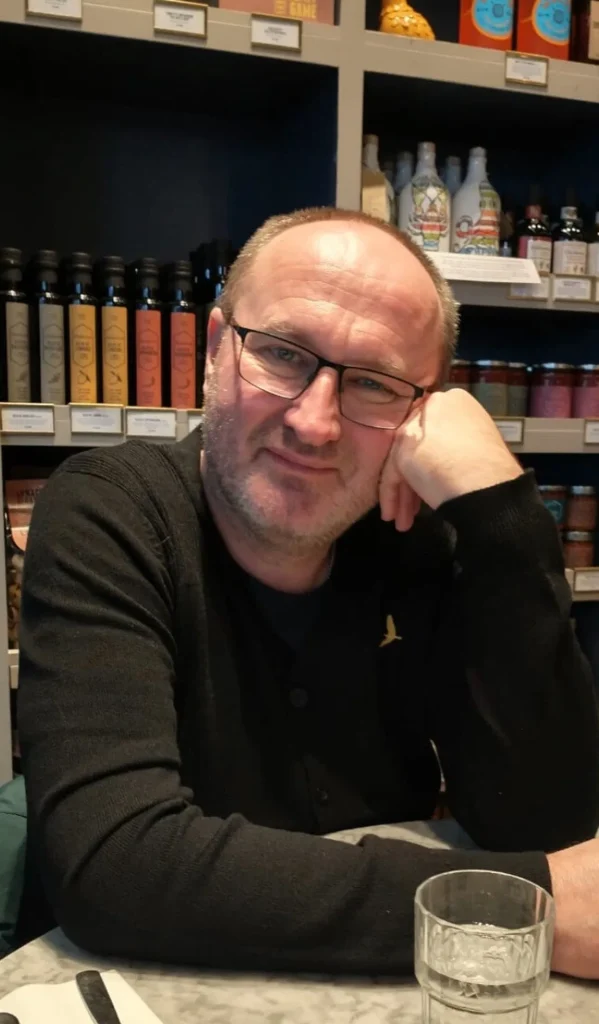
Alan Cox—aka The Gay Monogamy Coach—is a certified Life Coach and CBT Practitioner who spends his days helping gay men swap the “Soho Spin” for something more substantial. Working deep within the gay community, Alan specialises in helping men navigate the transition from the exhaustion of hook-up culture to the clarity of a monogamous relationship.
When he’s not untangling London’s dating dilemmas, you’ll find him hosting The Gay Monogamy Coach Podcast or writing. He is the author of numerous books (available on Amazon) tackling the vital issues that affect gay men and gay youth today.
Ready to get off the apps and find your match?
Web: www.lifecoachingempoweringgaymen.com
Email: empoweringgaymen@gmail.com