


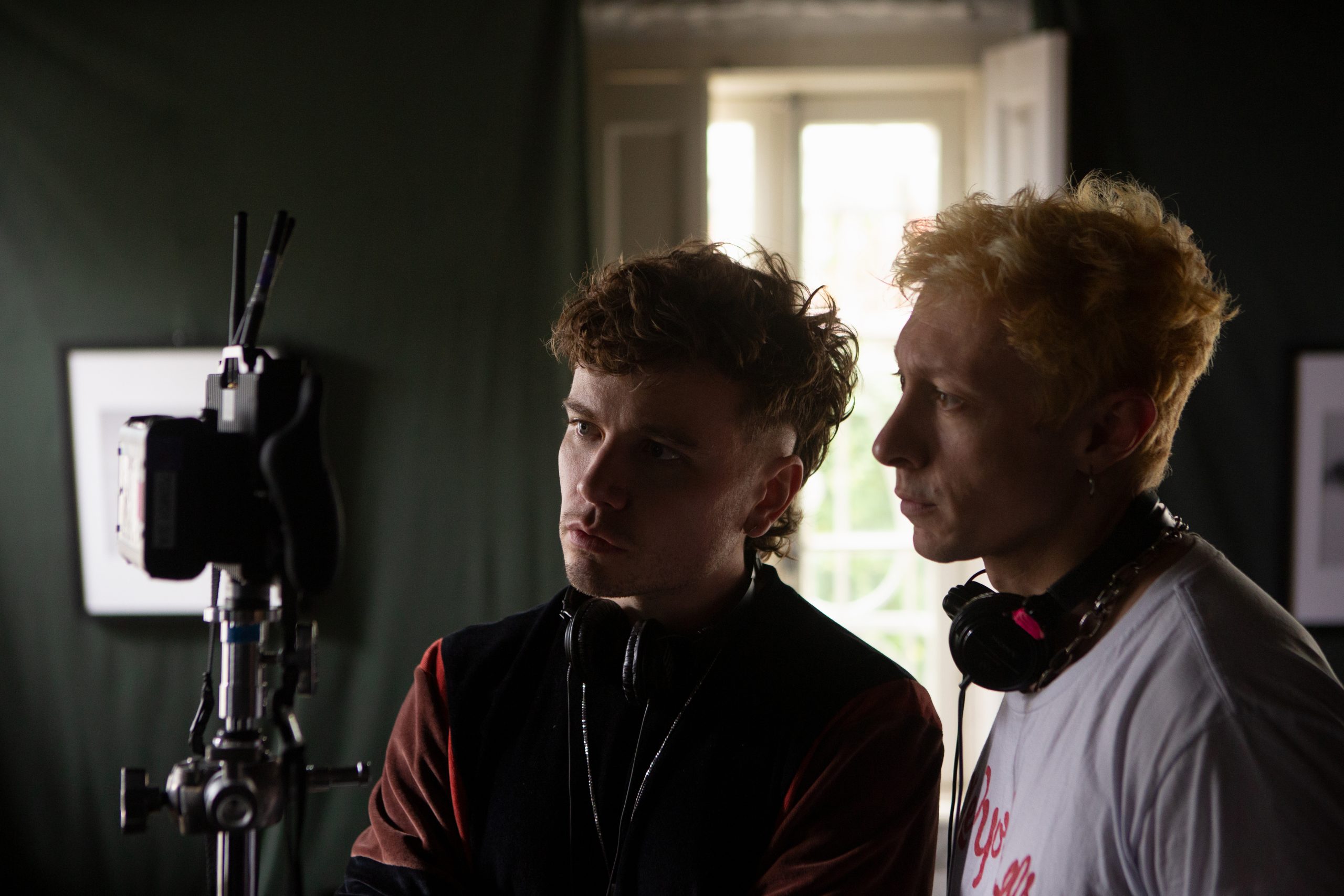
GLL interviews Directors Marcio & Filipe to discuss the film:
Night Stage sits somewhere between erotic thriller and character study. Did you always know you wanted to work within genre, or did that emerge as the story developed?
We’ve always been drawn to genre cinema, although this is our first time fully stepping into it. At the beginning, we imagined the film in dialogue with neo-noir, or even a more classical thriller. But as we developed the script, desire gradually moved to the center of the story, and that shift made us realize that the erotic thriller was the space where the film could truly breathe. At the same time, we were very interested in approaching that genre from our own perspective: bringing it into the present, and filtering it through a queer and Brazilian sensibility.
You describe performance and desire as the heart of the film. At what point did those two ideas click together for you?
We think they were always orbiting each other, even before we fully understood it. We started from a fascination with performance, not only in the literal sense of acting, but also the roles we play in public life, especially in environments shaped by power and visibility. Desire came in almost as a disruption to that structure. It exposes the cracks in those performances, it makes them unstable, sometimes even dangerous. At a certain point in the writing process, we realized that both ideas were actually inseparable. Desire is also a kind of performance, and performance is often driven by desire: to be seen, to be wanted, to belong. Once that connection became clear, it gave us a stronger spine for the film, and everything started to align around that tension between what is shown and what is hidden.
There’s a real sense of escalation, the encounters becoming riskier as the film goes on. What draws you to that idea of desire tipping into compulsion?
A response to the constant compromising of their identities and desires that the characters go through in order to reach an idea of success. In the end, that’s what it is. Desire gets suppressed, but it comes back, demanding space.
The camera often feels like a voyeur in its own right. How conscious were you of making the audience complicit in what they’re watching?
Going back to the genre you mentioned before, a key aspect of classic erotic thrillers is that they create a dynamic where the person being observed is an object of desire, but not always aware or in control of that gaze. The idea of subverting that and creating characters who know they are being watched, and who play with that, was always very interesting to us. Matias and Rafael look at the other characters who might be watching them, but they also look at the film’s audience, inviting them to take part in that night with them.
There’s something quite bold about framing a queer story within an erotic thriller… Was that part of the intention from the start?
First, out of a cinephile desire, since it’s a genre we love. And also because it speaks a lot to contemporary reality (whether queer or not). To take ownership of genres that have historically been cis, white, and heterosexual, and subvert them, is something very exciting. A disruptive and disobedient perspective can always bring a lot.
By day… Is that split specifically queer, or just human?
Within a neoliberal and capitalist society, individuals are pushed to constantly suppress who they are, their desires and identities, in order to achieve an idea of success and assimilation. But for people who belong to social minorities, there is an even stronger pressure to erase parts of their identity (and desire, or gender performance in the case of LGBTQ people) to move upward. It’s very cruel.
Rafael being a politician… What did that allow you to explore?
For us, having a politician as one of the main characters allowed us to explore another kind of actor: an actor of institutional politics, of campaign stages, of television. It’s someone who performs for investors, voters, and other politicians. But it was always very important for us to make it clear that the main antagonistic forces in the city are not necessarily the politician himself, but the capital interests behind him (which, in the end, can discard him and replace him at any moment).
You reference filmmakers like Brian De Palma and Paul Verhoeven. What did you take from those influences, and what did you want to subvert?
We feel that our cinema has always had an unapologetic quality to it, and that’s something we deeply recognize in these directors. We admire how fearless they are in their choices, particularly around desire.They’re also able to move across tones in a way that really interests us. And finally, they create cinema that plays with itself — with its own language and tools — without trying to conceal them.
Colour and movement feel central…
The idea of exploring performance (and actors) as the center of the film came very early on, and that led us to think of the entire film as a kind of theatrical stage from the beginning. We’ve also always been obsessed with bodies in motion: whether acting, dancing, in erotic scenes or in violence. That guided many of our choices.
Gabriel Faryas… what made you feel he was Matias?
When Gabriel walked into the room for the audition, there was an immediate presence — a kind of quiet glow that felt very close to Matias. Some people might call it star quality. As we talked, we realized we shared very similar political and artistic views, which made the character feel like something built collectively, by six hands. And of course, he’s a fantastic actor.
There’s a strong physicality… how did you build intimacy and trust?
We both come from a theater background. Marcio still acts. That makes us very interested in long rehearsal processes, where the actor is at the center. And working with actors who genuinely want to tell that story with us is essential. Once all that is in place, everything else flows naturally.
The soundtrack plays a big role…
The film’s sound work was one of the most beautiful parts of the process. We shot the film without the original score in place, and later Thiago Pethit, Artur Decloedt, and Charles Tixier came in and created a soundtrack that moves between desire and danger, seriousness and irony.
The film doesn’t moralise its characters…
Definitely. Especially when dealing with fetish and kink. We’re not interested in moralising a character’s decisions, but in observing how they make choices within a system — within contemporary society. Our role, as filmmakers, is to provoke and to disobey, not to moralise. We’re not priests.
What do you hope queer audiences take away…
First of all, to have fun. And to reflect on how much we give up on our desires and identities for a false promise of assimilation. And to understand that desire is an essential part of life, and of art.
Describe Night Stage in one sentence…
A film about two unlikely lovers who must choose between trying to fulfill the expectations of neoliberal success or following their desires.
What excites you most about bringing this film to UK audiences now?
We had a great screening at BFI Flare exactly one year ago, when Night Stage was the Closing Film. It was a beautiful session, a great discussion, and a very warm reception. We hope audiences continue to connect with it, and enjoy the film.
Night Stage runs until 9th April, for more info and cinema tickets, click here.
Keep an eye on the Peccadillo website for details of the VOD release.


